

How Shared College Lab Microscopes Wear Out Faster and How Blais Microscope Company Can Help

A college lab microscope can pass through dozens of hands in a single week. One student adjusts the coarse focus too quickly. Another wipes a lens with the wrong material. Someone carries it by the arm only. By Friday, a solid teaching microscope may have collected more wear than a lightly used instrument sees in months.
Shared microscopes are built for repeated use, but they still need care. The problem is not that students are careless. Most are learning. The real issue is volume, speed, and inconsistent handling.
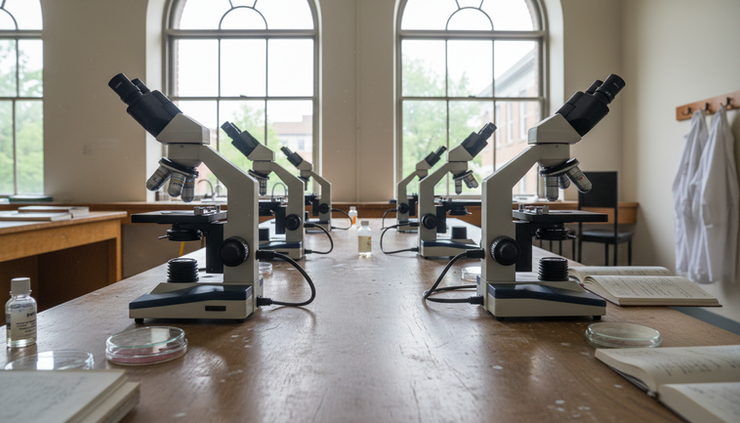
Why shared microscopes wear down faster
Microscopes in college teaching labs live a hard life. They are used by beginners, moved often, cleaned quickly, and stored under time pressure. Even a well-made microscope can drift out of alignment or lose image quality when small problems stack up.
Microscopes wear out faster in shared labs because the same parts get handled over and over:
Focus knobs
Objective lenses
Eyepieces
Stage clips and mechanical stages
Light controls
Power cords
Dust covers
Storage cabinets and carrying handles
In a research lab, one trained user may know the quirks of a microscope and handle it carefully. In a teaching lab, each user may treat the same instrument a little differently. That constant variation creates stress on mechanical and optical parts.
The most common damage in college lab microscopes
Most microscope problems do not start as dramatic failures. They begin as small issues that reduce image clarity, make focusing harder, or frustrate students during lab.
Dirty optics reduce image quality
Lenses collect fingerprints, immersion oil, dust, and residue from improper cleaning. Students may use paper towels, lab wipes, shirt sleeves, or general cleaners. These can scratch lens coatings or leave film behind.
The result is a cloudy image, poor contrast, or spots that stay in view even after the slide is moved.
Common signs include:
Hazy images at higher magnification
Specks that rotate with the eyepiece
Oil on the 40x dry objective
Smudges on eyepieces
Poor contrast even with proper lighting
Focus mechanisms loosen or bind
The coarse and fine focus knobs take a lot of abuse in teaching labs. New users often run the stage too far up or down. Some force the knob when it reaches its limit. Over time, the mechanism may loosen, slip, grind, or bind.
A microscope that will not hold focus makes lab work harder for everyone. Students may blame their slide, their eyes, or the assignment, when the real problem is mechanical wear.

Objective lenses get damaged or misaligned
Objectives are among the most important and costly parts of a microscope. In shared labs, they may be bumped into slides, dragged through immersion oil, or cross-threaded when removed and replaced.
A damaged objective can cause blurry views at one magnification while the others still look fine. A loose nosepiece can also keep objectives from clicking into the correct position, which affects alignment.
Stages and clips bend or loosen
Stage clips and mechanical stages get constant use. Students load slides quickly, push them against clips, or crank mechanical controls to their limits. Bent clips, loose stage movement, and uneven slide positioning are common in high-use classrooms.
When the stage does not move smoothly, students struggle to scan specimens. That slows down the lab and increases the chance of more forceful handling.
Lights and cords fail from repeated setup
Microscopes that are moved in and out of storage face extra wear on cords, switches, plugs, and light sources. A cord wrapped too tightly can weaken over time. A loose plug or flickering light may seem minor, but it can interrupt lab and create safety concerns.
Small habits that extend microscope life
Good microscope care does not need to be complicated. The best approach is to build simple habits into every lab period.
Use a short handling routine
Students should know the same routine before they touch a microscope:
Carry the microscope with two hands.
Place it on a stable lab bench.
Start with the lowest-power objective.
Keep the stage lowered when loading slides.
Use coarse focus only on low power.
Switch to fine focus at higher power.
Clean lenses only with proper lens paper and lens-safe cleaner.
Return the microscope to its storage position.
This takes little time, but it prevents many common problems.
Keep cleaning supplies at every station
If the correct supplies are across the room, students are more likely to use whatever is close. Place lens paper and approved cleaning fluid near the microscopes. Label them clearly.
Avoid general paper products, harsh cleaners, and anything abrasive. Microscope optics need gentle cleaning.

Assign quick inspection checks
A brief check after each lab can catch problems early. Teaching assistants or lab staff can look for:
Missing eyepieces
Oil left on objectives
Loose stage clips
Sticky focus movement
Flickering lights
Damaged power cords
Microscopes stored without covers
A simple log also helps. If the same instrument keeps showing problems, it may need service rather than another quick wipe-down.
When maintenance is better than replacement
Many microscope issues can be corrected with professional cleaning, adjustment, or repair. Replacing a full set of teaching microscopes can be expensive, especially for colleges with multiple lab sections. Maintenance helps protect that investment.
Professional service can often address:
Internal dust and haze
Stiff or slipping focus controls
Loose mechanical stages
Objective alignment problems
Electrical issues
Worn parts
Preventive cleaning before a new semester
A regular service schedule also helps departments plan ahead. Instead of waiting for microscopes to fail during a lab practical, instructors can identify weak instruments between terms.
How Blais Microscope Company can help
Blais Microscope Company can support college labs by helping keep shared microscopes clean, functional, and ready for instruction. For teaching labs, reliability matters. A student who cannot get a clear image loses time, confidence, and the chance to learn the technique properly.
A microscope service partner can help in practical ways:
Inspection and diagnosis
Technicians can identify whether a problem comes from dirty optics, mechanical wear, misalignment, lighting, or user damage.
Professional cleaning
Proper cleaning reaches beyond the surfaces students can safely clean during lab. This can improve image clarity and reduce frustration.
Repairs and adjustments
Loose stages, focus issues, damaged objectives, and lighting problems may be repairable. Fixing these issues can extend the usable life of your equipment.
Preventive maintenance planning
A planned maintenance schedule helps labs prepare before heavy-use periods, such as the start of a semester or a full week of biology sections.
Guidance on replacement
Some microscopes reach a point where repair no longer makes sense. Blais Microscope Company can help labs think through when to repair, when to replace, and what features matter for student use.

A simple plan for college microscope care
A good care plan does not need to be complex. Start with three layers.
Daily care
Weekly checks
Scheduled service
Students and lab staff clean exterior surfaces, check lenses, lower stages, wrap cords loosely, and cover microscopes.
Lab staff look for recurring issues, test lights, check focus movement, and note instruments that need attention.
A professional service provider inspects, cleans, adjusts, and repairs microscopes before small problems become lab-wide disruptions.
This kind of plan keeps microscopes in service longer and gives students a better learning experience.
Shared college lab microscopes work hard. They can handle years of use, but only if cleaning, handling, and maintenance keep up with the demands of the classroom. With better daily habits and support from Blais Microscope Company, labs can reduce downtime, protect their equipment budget, and give students clear views when it matters most.


Comments